Friday, October 19, 2018

Orwell-Windsor Cockney


Orwell had a big problem with Kipling's use of dialect in stories and poems; no soldier would recognise Kipling's dialogue: it often appears as comic stylised cockney; he looks down from a distorting class perspective Orwell concludes and goes on to translate barrack room ballads back into
standard English to get away from this romantic, empire-glorifying view.
Kipling spent several years as a provincial journalist in India mixing with soldiers, engineers and local people-a great lover of  detail and the world of things. He even imagines a story about a bridge building project told from the point of the view of the worker and specifies it should not be patronizing albeit narrated in dialect. Why would Kipling suddenly abandon a desire to make close observation in place of comic romanticisation?  Maybe people actually say 'follow me 'ome '

The problem lies with Orwell. Little survives of Orwell's speaking voice but people who knew him said that if he met working people he lapsed into Windsor Cockney (fancy a nice cappa tea lav) like the speakers who he ridicules in Kipling's Barrack Room ballads. Kipling was comfortable with people of all backgrounds and races; Orwell wasn't.

Saturday, November 4, 2017

Epistemological defeat


What is it like to be unable to know something-for example knowledge of the non human? Capek considered the case of talking newts; here humans simply exploited the alien as a resource. Lem's investigators sometimes do the same resorting to military or nuclear techniques to deal with the unknown entity (eg HMV)
In The Investigation and Chain of Chance the unknown is probability and coincidence. All the investigator can do in these cases is carry on with such techniques as exist and come up with can explanation however obscure even though the true cause is unknowable.Usually in Lem, investigators become anthropomorphic; Solaris researchers consult their own archives for clues. In HMV Rappaport suggests looking at science fiction for ideas to interpret the code. In Fiasco the idea is to use a cartoon display to get through to the aliens; after all every civilisation must use symbols of some sort. In summary, to talk to the non human we tell stories about humans. Phillip Dick's electric ant/android cannot know it is not human-it has to believe it is the same as the humans
Perhaps the best example of epistemological defeat is Kafka's dog which will never know how it's food originates; as the dog ponders it tells mystical dog-stories to itself about singing and hovering dog-entities- more imaginative stories than Lem's. This lead Walter Benjamin to conclude that Kafka's dog inhabited a place 'far away from the continent of man' thus occupying a more privileged epistemological position that any of the above.

Friday, October 13, 2017

Nearly Victor Serge

I was nearly Victor Serge; Like him I  was also a 'dissident's dissident'. Everyone said I had the look of Basque Beatnik-frizzy hair, jaunty scarf and Trotsky glasses. I may not be working class but I can do a good scouse accent. I have published a book about him; I've tried be like him; sometimes I think I am him.
I know that part of me was with him at Kronstadt; I swear we were together at Petrograd when Trotsky's War Train steamed in and drove the Whites out. Together with Pankratov, Eltsin and other Trotkyist comrades we served our years in exile at Orenburg
I have lived by his code. I have served with The International Socialists (IS) in York and Leeds; Like he would have done I split with IS over entryism as I did over Hungary.
But recently he has grown more distant to me. I now realise Shipley cannot be Mexico. I've been going through some of his last papers and as I walked home last night by the Shipley canal V spoke to me:
  a night filled with stars; a darkness filled with you


Monday, May 23, 2016

Kudo and Ionesco

We know Tetsumi Kudo and Ionesco fell out during the making of La Vase; looking at how Kudo went on to use Ionesco in his work. it must have been a very serious misunderstanding. Ionesco's head (right) plays a special part in Kudo's  Pollution-Cultivation-New Ecology programme.
First 'pollution' (deconstruction): here Ionesco moults or sheds his body parts which are hung around his head in a tiny cage, displayed as ornaments; also included a tiny crucifix, little chits with 'merci' written on them and what looks like a glass of Chimay. The caption for this work is 'end of some generation'  ie end of Euro/Christian/ Humanist generation; Ionesco's face is the face of this generation.
That is not the end of the story: after 'pollution' and 'moulting' cultivation can begin. Ionesco's parts reassemble, uncaged, democratically living alongside other organic and non-organic elements; his head is now growing but notice the electronic circuitry. Finally (below) Ionesco is free to develop in a hydroponic sphere part of a New Ecology flourishing, wired up, among plants, valves and reproductive organs. Amazing what can happen to an aging, surrealist intellectual. He'd be grateful.


Wednesday, November 11, 2015

dreamy smurf

Snowden has told us something new about NSA/GCHQ; they have an instrument, styled Dreamy Smurf, for taking  over your phone and instructing it to take pictures-presumably of you. From Snowden we also now know more about NSA's in-house graphic design styles usually derived from magic and fantasy (smurfs?). More interestingly another Snowden slide contains an image of an online game called Shadowfist  in which a monkey fights a robot. We already know that the CIA recruit from young Xbox wizards for their drone bombing controllers. There is an art form (Machinima) which uses video game technology to make films. Feng Bo  is a Chinese '8 bit' artist, famous for The Long March, a pixellated account of Mao's struggles.Ahmed El Shaer, more adventurously, in his work Nekh, tackles the Tahrir square camel battle in Cairo in the now-forgotten Arab spring: in the game aspect of Nekh nobody wins- hopefully the Mukhabarat don't have an 8 bit section.
There is a new genre emerging: SIGDEV is the overall term for the world of surveillance. What about SIGART?  Candidates are Dreamy Smurf and Shadowfist.  But El Shaer's Venice Biennale video installation Green is more complex: the colour geeen is manipulative; mosques are often green; in Green there is a 'green'  terrorist organisation. SIGART embraces the art  of the Watcher (Shadow Fist) and the Watched as they watch each other.

Monday, July 28, 2014

spy toaster

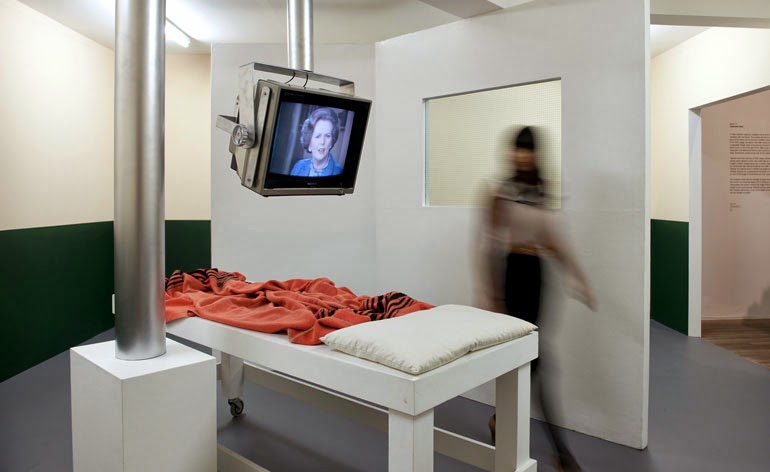
Hamilton's Interior containing Thatcher's TV image gazing upon a seedy NHS space moves out of the interior and swiftly mutates into the ubiquitous Toaster; we, the viewer now gaze at the shiny, metallic structure; it reflects our faces and other faces merging our identities. It is a surveillance rather than a consumerist aesthetic. The job of the Toaster  (breakfast) is forgotten and a new principle of usage arises; we use our shiny appliances and the people at GCHQ  use that use. Hamilton wished to investigate the epic in everyday objects; he was re-examining Toaster as late as 2008; Toaster de luxe 1 is both epic and secret expressing Government's insatiable desire for machines that can can capture all information irregardless of its value.

Monday, September 16, 2013

Wei Wei at 5000 feet

Since Edward Snowden we should be talking about surveillance: not so; either it is accepted as inevitable or desirable or OK up to a point. Artists don't see it like that. Certainly not Wei Wei whose Disposition allows the viewer to gaze into boxes within which he is gazed at by Chinese guards while he sleeps or sits on the toilet. Richard Hamilton's Treatment room shows us a seedy, institutional interior evoking NSA/GCHQ's surveillance of Yahoo user's  intimate, shared photos.
 But Art can deal with surveillance in many ways: Arnall's Robot Readable World goes inside the  black box and represents the CCTV material as 'found footage'. The Bureau of Inverse Technology (BIT) fly their own drone and can look down on the watchers (NSA and GCHQ). Or what about collaboration? In Luksch's The Eye dancers run through Busby Berkeley routines under CCTV and then request the footage from the data companies. Another form of collaboration is to deconstruct the 'found footage' and reflect on the 'uncanny- is the figure on the footage really there or is it a doppelganger? Omer Fast's Better at 5000 feet talks to the drone operators as they wax lyrical about the 'white blossom' or heat signature of potential targets. It has been noted that drone operators come from the X Box generation. Two forms of drone-operator- playfulness exist: the aesthetic appreciation of  'white blossoms' or X Box frenzy. Figures dodging behind boulders in the Yemeni desert must hope for the former and can request the found footage from the CIA.
Wei Wei shows us the way: he follows the secret police in his car even snatching the agent's ash tray complete with fag ends and relocating it in an art exhibition as found object.  But how do we reclaim the digital traces of us that GCHQ routinely hoover up, turn them into refound footage and display as art? Well:  Arnall and Luksch have made a start.

  • in Elmgreen and Dragset's Phone Home visitors to the installation can connect with friends and family worldwide (free) while other visitors can monitor their calls in an adjacent room.
  • Jud and Wachter in Berlin set up a wifi network (can you hear me) on the Swiss embassy to relay their own messages to NSA/GCHQ posts on nearby embassies.
  • Simon Denny's Secret Power looks in detail at the visual style that went into the power point slides that Snowden took from the NSA. Although the viewer cannot 'phone home' we can follow the same interpretive steps as the NSA analysts.
  • Take another look at the slides in Secret Power specifically the GCHQ slides depicting Online Covert Action; imagine the mental states of the analysts who create this Tower of Babel; to reverse this algorithmic damage they need to use Taryn Simon's Image Atlas. Here is a drill for using the Atlas: take each term from each box in the Snowden slide ACNO-key skills strand and feed them one by one into the Image Atlas search engine.
  • Paglen has deconstructed the Facebook algorithm which scans our images for dress style and repurposed it so only images relevant to Freud and Marx are selected, He also is planning an orbiting satellite which has no use or purpose (ie spying); it will be an aesthetic object-simply to look at.


Friday, July 19, 2013

alfred jarry's bike


Look carefully at Duchamp's Bride stripped bare by her batchelors . The work represents uperinteractions among unseen, abstract forces; it is also a machine of suffering. In the top part is what is known as 'the glider'; this is not a glider; it is a bicycle.Duchamp is here referencing Alfred Jarry's Clement Luxe machine purchased in 1896 (we know of course of Duchamp's interest in cycle wheels). Jarry's biographer (Brotchie) by way of some cod algebra assesses Jarry's gear ratio to be 36/9. This ratio will just work. BMX fanatics say it would be like leg pressing 1500 pounds maybe even breaking the chain. Andre Raffray painted the shadow of Duchamp's bicycle wheel onto a wall. He is commenting on Jarry's dream of a fusion between humanity and bicycle mechanics-the shadow reiterates Duchamp's thoughts on such a union-he invites the viewer to spin the wheel: to spin on an upside down unicycle-a more interesting comment than Ballard's 'assassination of Kennedy as a downhill motor race'; look at the detail in Jarry's 'crucifixion as an uphill bicycle race'; instead of crucifixion nails there are 'jiffies' or tyre levers; Jesus even rides lying flat to combat air resistance. How bland by comparison is Ballard's race.
Lance Armstrong should take a leaf out of Jarry's book; before or during a ride he might consume 2 litres of white wine plus a few absinthes followed by coffee and brandy; he called alcohol superfood-the source of all power. Using this as a template Lance can redescribe his endeavours as 'had some great superfood', 'had much better EPO in training this winter', 'check out this synthetic testosterone'.
Lance is the supermale. Jarry would have been. impressed at the range of superfood that Armstrong consumed-far more efficacious than alcohol; 10.000 mile race against a train-no problem

Tuesday, April 16, 2013

refuges 2


lives of writers have a performance aspect: nothing wrong with living in North London and going to book festivals: not necessary to live like Kerouac nor to act like Marina Abramovic using yourself as an object of art. But Bernhard saw his life in dramatic terms elaborately staging his funeral, will and legacy-all mini performances.
Bernhard's 'life performances' are hardly riveting. Think of Alfred Jarry, another writer/performer: androgynous ephebe with a punchinello voice dressed in hooded cape and Louis XV heels-associate of Bonnard, Lautrec and Apollinaire-interchangeable with Ubu.
Specifically: contrast the habitats of Bernhard and Jarry: Bernhard's farmhouse/castle at Obernathal full of empty rooms and galleries with shuttered windows; Bernhard acting as Hapsburg- farmer- manque, astride his tractor, dressed in lederhosen or posing in Vienna coffee houses. Better if he had watched visionary artistic personas like Beuys or Filiou  on Youtube-imagine Bernhard on Youtube! Think further of Jarry's 'tripod', 'horrific tower' by the Seine, 3.33 x 3.67 , one room with earth floor-bit like a beach hut plus live owls for company; the only photograph of the 'Tripod' captures goats looking in the door. Ubus's cave versus  Heideggers Todtnauberg.
Jarry was a precursor of Dadaism, Duchamp and performance art etc: the idea of the artist setting out to deconstruct his own play during the first night (Ubu) is a century before its time. But who are Jarry's precursors?
If artists are to be performers as well as artists perhaps they should be shamen in which case they may as well be good at it (Beuys and Kudo) rather than poseurs like Bernhard.
Thinking of Beuys, Jonathan Jones (Damien Hirst acolyte) described him in The Guardian recently as a bullshitter. Presumably Jones is thinking of Beuys' war time 'saved by felt and fat' experience. It troubles Jones that Beuys made it up; isn't that what 'performance' is?
Beuys worked with energy rich materials like felt, fat, honey and batteries-materials that nourish, warm and protect. Abramovic explains that the energy is retained in these materials so that Beuys doesn't need to be there anymore. Jones refers to these materials as 'turd like excresences' . If this energy is lost to the viewer as in Jones's case all that remains is bullshit and turds

Thursday, February 21, 2013

beyond bernhard

Bernhard could have made better use of his lengthy hospital visits: he speaks of the 'death ward' or the 'theatre'-not operating theatre but one where the patients are marionettes connected to machines by strings not tubes. From these experiences he develops a system of pointlessness-getting up in the morning to face a pointless task, then setting to work and thinking oneself into bitter pointlessness'-something his grandfather had done each day starting at 3.0am. He should have further developed the idea of 'theatre' and gone in the direction of Kafka's Burrow and there encountered calculated pointlessness.The burrower richly pays for his underground castle keep by  pounding the loose sand with his forehead thousands and thousands of times to harden it; Bernhard never got to the bottom of pointlessness.

Friday, November 23, 2012

the whole equation

e
Brecht, in a letter during the war, describes American soldiers on a train talking to each other;  no country, he says, has made itself familiar as this one, through the cinema. David Thomson develops this simple idea in his discussion of Chinatown; if you live in the US you can't help dropping into some of the dialogue from the film-'well nobody's perfect' and so on. Further, as time goes by, LA themes in the film (exploitation, greed etc) come to look like 'real' LA This is his idea of 'the whole equation'-we see ourselves as if in a film. This notion has obvious appeal for J G Ballard. Does our world view, he wonders, come from Disney or Canterbury Cathedral. Or, he goes on, how would the equation work in Japan or Sweden-psychotic stares or glacial silences?  Or what about the UK? -Passport to Pimlico or Brief Encounter
Brecht concludes, re the train episode, that 'maybe the movies don't tell the whole story'. So film and life don't equate? They don't have to: consider Jan Nemec's Late Night Talks with My Mother. There is a connection between this film and Oratorio for Prague  together with The Ferrari Dino Girl  but it is up to us to work out what the equation is or make up our own equation from elements like Skvorevsky, jazz, east european jazz, Boruvka etc.

Tuesday, September 25, 2012

children on a country road

In Kaurismaki's Le Havre Elina Salo reads to Kati Outinen, while she is ill in hospital, from an unusual text: Kafka's Children on a Country Road. Specifically she reads the concluding lines 'just think they never sleep...because they are fools'. Now Kaurismaki's work abounds in references to writers, often French; eg Micheaux and Prevert; but does the Kafka quote denote more than referentiality?  Benjamin discusses a clan of sleepless types who occur through Kafka: students, assistants, waiters, residents of the city in the south. About the faces of these figures he notes that Kafka says 'they seem to be those of grown ups, perhaps even students'. Kaurismaki does not derive films from Kafka but the 'grown up' look of the students may be very similar to Kati Outinen's persistent unblinking stare.

Wednesday, September 5, 2012

eternal noon

Bela Tarr's The Turin Horse is hard to watch; a man and his daughter spend their days in a remote farm house while a storm blows continually outside.Each day the routine is the same: she helps him dress, keeps the stove going, goes out to get water from the well in the wind, feeds the horse, and finally prepares a meal, always the same, of a boiled potato which they eat with their fingers at a bare table and so on recurringly. In due course the well dries and the horse flags; they attempt an escape but return and go back to the same routine. Perhaps Nietzsche had a couple like this in mind when he came up with his idea of Eternal Recurrence (ER); each moment in their life will recur; to the daughter going each day to the well Nietzsche says 'etch the image of eternity onto your life'.
Tarr quotes from Nietzsche at the beginning of the film. Perhaps he wants to reveal to us a flavour of ER or perhaps he has in mind a further thought; there is now a proposal that by fasting we can significantly extend our lives; rats on a restricted diet live longer. Imagine a time when large numbers of 120 year-olds exist; they will be very healthy with gleaming skin and bright eyes although many of them (notwithstanding medical breakthroughs) will have Altzheimers. For them, trapped in an eternal noon, the present will eternally recur. Watching The Turin Horse does feel like ER; the actors in the film will have experienced ER; the film may be a good picture of what ER is like; nor will the persons caring for the vacant 120 year-olds (with or without Althzheiners) escape eternally recurring boredom.

Friday, August 3, 2012

mark rylance and the nature theatre of oklahoma


Potential recruits for Kafka's Nature Theatre of Oklahoma (NTO) face an unenviable task: it is not clear what is expected. The Theatre is vast, all embracing and has no limits; it is nature itself. Recruits bring a prior self with them which they will now lose. But it is a leap in the dark with no obvious redemption; it is a theatre but actors are not being enlisted. On duty is the usual cast of clerks, bureaucrats and assistant bureaucrats with the addition of extras dressed as angels. Karl tries to clarify what is expected; do they want engineers, technicians or actor? are qualifications required? are European credentials accepted in Oklahoma? He has no papers; is that a problem? No answer. Finally he is assigned the role of minor technician with the name Negro. Having left one self behind the NTO cannot tell entrants what their new self is to be; would-be 'actors'  have to guess-I am not who I was but I don't know who I now am.
It is not a situation that calls for a therapist; Susie Orbach or Adam Phillips can't help these lost souls; the trick is to juggle many selves. Karl does this; he can be an actor, engineer, technician-whatever they want. He is a good liar. Mark Rylance calls this 'using yourself'';  in fact he does juggle with multiple selves; there is the prior self that he fears; the next self which the play offers and a third self through which he comments on the first two. It can be unnerving ie when he loses Rooster Byron for a while; lying and self lying certainly feature. Rylance can also use his 'self' to explain other 'selves' Watch The Grass Arena for example and then Barbaric Genius: John Healey's 'self' has been amplified
There is hope for actors joining the NTO.

Thursday, May 31, 2012

damien hirst and bauhaus

Here is Damien Hirst at one of the most fabulous events of the party season-the Motilo 'with love' party at London's Le Baron; Damien is dancing with Anna Machkevitch in the smokily lit lazer-effect club area.80 years ago another party took place at a Bauhaus gathering; here little Bauhausers are decked out futuristically in tube or metal attire. The current Barbican exhibition is aptly titled 'Art as Life'; there is sculpture, textile,dolls, theatre, posters and photography including shots of bauhausers at play (gymnastics and metal parties)-art as life or a way of life.

Wednesday, April 25, 2012

Picnoleptic suggestions for the Chinese Politburo

co The Poliburo of the Standing Committee of the Communist Party of China (PSCCCC) vigilantly  attends to all the material and psychic needs of the citizens. The citizens also need to be vigilant especially when interruptions occur in PSCCCC thinking. Recently Wen Jiabao warned against a return to the Cultural Revolution.Was he thinking of the overly zealous local actions of Bo Xilai and his wife? Or did he have in mind the ups and downs of Confucianism; once seen as midieval and next as fostering loyalty to the state but now perhaps a political threat?  The PSCCCC could learn from Kafka's Great Wall of China; workers on the wall operate a system of piecemeal construction so that once a 1000 yards is completed then, after due celebrations, the High Command transport them faraway to start another 1000 yard section; on this journey they see innumerable other partial sections of wall in the process of completion accompanied by the usual celebrations and so on for ever. These are stories of the mass management of peoples which pay careful attention to the mental states of wall builders; only this section of wall is ever visible. But yet more care could be lavished on the worker's soul. Specifically what is the optimal mental state for perpetual interruption? How do I best cope with only ever experiencing a 'bit' and never a whole? It is possible to make mass use of Virilio's idea of  picnolepsy where the worker's ego is not continuous but made up a series of little deaths with fits; during each fit there is no awareness only oblivion. It is in principal possible to calibrate the timing of fits with those moments when the High Command is planning to move wall workers to a new location; a process of inducing oblivion is required; the PSCCCC can adopt a similar routine to coincide with their periodic ideological interrruptions To imagine this, from the perspective of the worker's experience, just take a look at the fitful aspect of many of the dance sequences in Pina Bausch's Cafe Muller. The figures shake and convulse. Perhaps Gombrowicz is thinking of these Chinese wall builders when he talks about the 'grimace'; a picnoleptic fit is sure to make the victim grimace like the 'grimace duellists' in Ferdydurke.

Tuesday, April 3, 2012

damien hirst and Munch


Damien Hirst gets helpers to finish or do all of this art work. He says 'I can't be arsed doing it'. Houellebecq in his recent novel depicts Hirst and Koons dividing up the art market for fun. Why not go a step further and be like Tom Ripley who invents a fictional artist to make money: Derwatt. Derwatt acquires a reputation and value even though the paintings are fakes. There is a difference as Ripley gets Bernard Tufts, another character, to do the fakes. We never see Derwatt. Ripley invents the idea that the artist is living in Mexico. It is a pity Hirst lacks the bottle to do the same. We might hear more about all the underpaid Bernard Tufts (not even the mininum wage) that he employs to do his work so we'd never  have to see or listen to him;
Imagine if Peter Watkins was to make a film about Hirst following the method he uses in his film about Munch. Watkins criticizes the monoform nature of much cinema-fast paced linear narrative to keep people in their seats. In his film about Munch there is not one form but many. Almost in one shot we hear the artist coughing (TB), see an image of his childhood (more TB), one of his portraits and footage of writers etc who formed his intellectual milieu (Strindberg et al); also, spoken over, is a timeline of his era. How are these levels of representation to be worked out for Damien Hirst? If Watkins was to make a film (Munch-like) of Damien Hirst he can find material for every representational level from Youtube:

  1. Damien + mates shouting and swearing at the Groucho club
  2. an image of some his 'spots'-the ones he bothered to do himself
  3. timeline of his era-Trump, Kardashian, Jade Goody (for sentiment)
  4. Similar to Munch coughing the Hirst film needs kitsch sound to accompany the 'spots'; available from Amazon are Kitchen Craft-n-Fun Animal Sound Magnetic Clips (Energy Class A+). Each clip (spot) makes the noise of the pictured animal and is activated by simply opening the clip (spot). The clips (spots) have a magnet to fix on your fridge.


Wednesday, February 8, 2012

aeneas and klaus weber's ape

In the Aeneid, Aeneas is shown pictures of a far future which contains events and characters which are beyond his immediate comprehension. He has this experience more than once in the Aeneid. It happens to him in the Underworld after which he has to exit said domain via the Ivory Gate, the gate of false dreams. He cannot go out via the Gate of Horn (for dreams that will come true) for then he will see the future; he handles Venus' shield running his eyes over each piece and turning it over and over with his arms and hands. He 'delights in the likeness' much as chimps do; much as Klaus Weber's 'shape of the ape' does, seeing, wondering but not comprehending. Within the shield Aeneas dimly senses future images of Caesar Augustus, Anthony and Cleopatra. Klaus Weber's ape also dimly senses images: the images of Darwin, Lenin, the Nazis.


Thursday, October 27, 2011

Tiresias' advice to Ulysses


In Horace's Satire 2-5 the poet reflects on the section of The Odyssey in which Ulysses descends into the underworld and there meets, amongst others, Tiresias, the blind prophet of Thebes. Tiresias can prophesy the future even in the underworld. He paints a picture of what awaits Ulysses: it is not a smooth, sweet journey home. Instead ship destroyed, men destroyed, he will find a world of pain at home- arrogant men devouring his goods. When Horace revisits this scene only the last prophecy interests Ulysses-money and goods. How can I regain my lost wealth he asks the Prophet who, surprised, remarks it ought to be enough to make it back to Ithaca and set eyes on his ancestral home. However if Ulysses is only interested in money then here are some lfrom the blind seer: he is to identify in Rome wealthy, childless and preferably witless landowners and ingratiate himself with them and thereby inherit their will-ie become a legacy hunter with all the self abasement that is required. Ulysses examines his soul and concludes that in former days (at Troy) he endured greater trials so he can surely endure this. Tiresias then provides a lengthy list of ideas of how this is to achieved: use flattery, creep up unobtrusively, don't overdo it; prostitute Penelope if required and so on. Fraenkel, the great German scholar, considered this satire to be acid, cynical and lurid. Not Horace's true nature. What about epode 8 (the one about his ex girlfriend's black teeth and decrepit age)?
Returning to the underworld imagine now Horace and Fraenkel (he is there- still groping his Oxford female seminar students) together  with Ulysses. Imagine further standing before these lost souls Tiresias now as Grayson Perry's The Father in pilgrim attire decked out with rags, tools, weapons and dangling behind the little, ursine talisman/god Alan Measles. No more lengthy descriptions of the future underworld careers of the assembled; instead the ragged figure raises his pilgrim stick aloft and Alan Measles appears aloft, long arms hovering over the company proclaiming HOLD YOUR BELIEFS LIGHTLY
The Father: a wise, enduring and resourceful figure-Alan Measles dangling behind him; compare to Israeli soldiers shambling back from the destruction of Gaza (handy being able to walk to work), the city reduced to rubble and flames, calling forth drones, rockets, jet bombers, missiles and tanks. The Sky TV channel Eurosport, during cycling races, carries an Israeli tourist board ad-Israel; land of creation; better is land of death and  destruction.

Friday, September 9, 2011

more on Odradek


W Benjamin sees Odradek as the 'the commodity that survives to no purpose' and through whom 'surrealism may come to an end' mutating into kitsch which sustains itself on an outlived world of things. Surely the point about Odradek is that it does survive and persist-in attics, doorways and at the bottom of stairs in various houses. For Odradek to be a kitsch object it would have to had a earlier purpose or immediacy since lost or outlived. Kafka says: 'anything that dies has had some kind of aim in life, some kind of activity, which has worn out; but that does not apply to Odradek'. Odradek has not lost shape or broken down having once been new and complete; 'nowhere is there an unfinished or unbroken surface' to suggest it is a 'remnant'.It is eternally complete and unchanging. That is what makes the Householder anxious when he bumps into it leaning against the banisters. Odradek endures yet he and his family will not. What if Kafka's householder had bumped into one of Orozco's yellow scooters while wandering round Prague in that period? More fun that meeting Odradek again. According to Benjamin when Orozco places his yellow scooters around cities his hand is catching hold of these objects (as if in a dream) at their most threadbare and timeworn point. But if someone walks past one of the yellow scooters surely he/she is able to see it as a use of kitsch itself. What would Benjamin have made of Svankmajer's A Week in the House?  Svankmajer is a fully paid up surrealist who hardly deals in the 'decrepit' aspect of objects-he may even be inspired by the 'threadbare and the timeworn': they have eloquence and a latent sensibility through being touched and heard- 'these objects are not dead artefacts to me. I lovingly give them starring roles in my films'. Svankmajer is an alchemist animating and reanimating the secret life of objects.