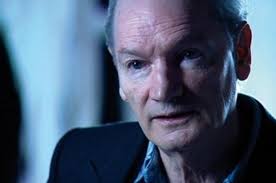
In Kaurismaki's Le Havre Elina Salo reads to Kati Outinen, while she is ill in hospital, from an unusual text: Kafka's Children on a Country Road. Specifically she reads the concluding lines 'just think they never sleep...because they are fools'. Now Kaurismaki's work abounds in references to writers, often French; eg Micheaux and Prevert; but does the Kafka quote denote more than referentiality? Benjamin discusses a clan of sleepless types who occur through Kafka: students, assistants, waiters, residents of the city in the south. About the faces of these figures he notes that Kafka says 'they seem to be those of grown ups, perhaps even students'. Kaurismaki does not derive films from Kafka but the 'grown up' look of the students may be very similar to Kati Outinen's persistent unblinking stare.
Tuesday, September 25, 2012
Wednesday, September 5, 2012
eternal noon

Bela Tarr's The Turin Horse is hard to watch; a man and his daughter spend their days in a remote farm house while a storm blows continually outside.Each day the routine is the same: she helps him dress, keeps the stove going, goes out to get water from the well in the wind, feeds the horse, and finally prepares a meal, always the same, of a boiled potato which they eat with their fingers at a bare table and so on recurringly. In due course the well dries and the horse flags; they attempt an escape but return and go back to the same routine. Perhaps Nietzsche had a couple like this in mind when he came up with his idea of Eternal Recurrence (ER); each moment in their life will recur; to the daughter going each day to the well Nietzsche says 'etch the image of eternity onto your life'.
Tarr quotes from Nietzsche at the beginning of the film. Perhaps he wants to reveal to us a flavour of ER or perhaps he has in mind a further thought; there is now a proposal that by fasting we can significantly extend our lives; rats on a restricted diet live longer. Imagine a time when large numbers of 120 year-olds exist; they will be very healthy with gleaming skin and bright eyes although many of them (notwithstanding medical breakthroughs) will have Altzheimers. For them, trapped in an eternal noon, the present will eternally recur. Watching The Turin Horse does feel like ER; the actors in the film will have experienced ER; the film may be a good picture of what ER is like; nor will the persons caring for the vacant 120 year-olds (with or without Althzheiners) escape eternally recurring boredom.
Friday, August 3, 2012
mark rylance and the nature theatre of oklahoma
Potential recruits for Kafka's Nature Theatre of Oklahoma (NTO) face an unenviable task: it is not clear what is expected. The Theatre is vast, all embracing and has no limits; it is nature itself. Recruits bring a prior self with them which they will now lose. But it is a leap in the dark with no obvious redemption; it is a theatre but actors are not being enlisted. On duty is the usual cast of clerks, bureaucrats and assistant bureaucrats with the addition of extras dressed as angels. Karl tries to clarify what is expected; do they want engineers, technicians or actor? are qualifications required? are European credentials accepted in Oklahoma? He has no papers; is that a problem? No answer. Finally he is assigned the role of minor technician with the name Negro. Having left one self behind the NTO cannot tell entrants what their new self is to be; would-be 'actors' have to guess-I am not who I was but I don't know who I now am.
It is not a situation that calls for a therapist; Susie Orbach or Adam Phillips can't help these lost souls; the trick is to juggle many selves. Karl does this; he can be an actor, engineer, technician-whatever they want. He is a good liar. Mark Rylance calls this 'using yourself''; in fact he does juggle with multiple selves; there is the prior self that he fears; the next self which the play offers and a third self through which he comments on the first two. It can be unnerving ie when he loses Rooster Byron for a while; lying and self lying certainly feature. Rylance can also use his 'self' to explain other 'selves' Watch The Grass Arena for example and then Barbaric Genius: John Healey's 'self' has been amplified
There is hope for actors joining the NTO.
Labels:
Adam Phillips,
Kafka,
mark rylance,
Susie Orbach
Thursday, May 31, 2012
damien hirst and bauhaus
Here is Damien Hirst at one of the most fabulous events of the party season-the Motilo 'with love' party at London's Le Baron; Damien is dancing with Anna Machkevitch in the smokily lit lazer-effect club area.80 years ago another party took place at a Bauhaus gathering; here little Bauhausers are decked out futuristically in tube or metal attire. The current Barbican exhibition is aptly titled 'Art as Life'; there is sculpture, textile,dolls, theatre, posters and photography including shots of bauhausers at play (gymnastics and metal parties)-art as life or a way of life.
Wednesday, April 25, 2012
Picnoleptic suggestions for the Chinese Politburo
co The Poliburo of the Standing Committee of the Communist Party of China (PSCCCC) vigilantly attends to all the material and psychic needs of the citizens. The citizens also need to be vigilant especially when interruptions occur in PSCCCC thinking. Recently Wen Jiabao warned against a return to the Cultural Revolution.Was he thinking of the overly zealous local actions of Bo Xilai and his wife? Or did he have in mind the ups and downs of Confucianism; once seen as midieval and next as fostering loyalty to the state but now perhaps a political threat? The PSCCCC could learn from Kafka's Great Wall of China; workers on the wall operate a system of piecemeal construction so that once a 1000 yards is completed then, after due celebrations, the High Command transport them faraway to start another 1000 yard section; on this journey they see innumerable other partial sections of wall in the process of completion accompanied by the usual celebrations and so on for ever. These are stories of the mass management of peoples which pay careful attention to the mental states of wall builders; only this section of wall is ever visible. But yet more care could be lavished on the worker's soul. Specifically what is the optimal mental state for perpetual interruption? How do I best cope with only ever experiencing a 'bit' and never a whole? It is possible to make mass use of Virilio's idea of picnolepsy where the worker's ego is not continuous but made up a series of little deaths with fits; during each fit there is no awareness only oblivion. It is in principal possible to calibrate the timing of fits with those moments when the High Command is planning to move wall workers to a new location; a process of inducing oblivion is required; the PSCCCC can adopt a similar routine to coincide with their periodic ideological interrruptions To imagine this, from the perspective of the worker's experience, just take a look at the fitful aspect of many of the dance sequences in Pina Bausch's Cafe Muller. The figures shake and convulse. Perhaps Gombrowicz is thinking of these Chinese wall builders when he talks about the 'grimace'; a picnoleptic fit is sure to make the victim grimace like the 'grimace duellists' in Ferdydurke.
Labels:
confucius,
Gombrowicz,
Kafka,
Pina Bausch,
virilio,
wen jiabao
Tuesday, April 3, 2012
damien hirst and Munch
Damien Hirst gets helpers to finish or do all of this art work. He says 'I can't be arsed doing it'. Houellebecq in his recent novel depicts Hirst and Koons dividing up the art market for fun. Why not go a step further and be like Tom Ripley who invents a fictional artist to make money: Derwatt. Derwatt acquires a reputation and value even though the paintings are fakes. There is a difference as Ripley gets Bernard Tufts, another character, to do the fakes. We never see Derwatt. Ripley invents the idea that the artist is living in Mexico. It is a pity Hirst lacks the bottle to do the same. We might hear more about all the underpaid Bernard Tufts (not even the mininum wage) that he employs to do his work so we'd never have to see or listen to him;Imagine if Peter Watkins was to make a film about Hirst following the method he uses in his film about Munch. Watkins criticizes the monoform nature of much cinema-fast paced linear narrative to keep people in their seats. In his film about Munch there is not one form but many. Almost in one shot we hear the artist coughing (TB), see an image of his childhood (more TB), one of his portraits and footage of writers etc who formed his intellectual milieu (Strindberg et al); also, spoken over, is a timeline of his era. How are these levels of representation to be worked out for Damien Hirst? If Watkins was to make a film (Munch-like) of Damien Hirst he can find material for every representational level from Youtube:
- Damien + mates shouting and swearing at the Groucho club
- an image of some his 'spots'-the ones he bothered to do himself
- timeline of his era-Trump, Kardashian, Jade Goody (for sentiment)
- Similar to Munch coughing the Hirst film needs kitsch sound to accompany the 'spots'; available from Amazon are Kitchen Craft-n-Fun Animal Sound Magnetic Clips (Energy Class A+). Each clip (spot) makes the noise of the pictured animal and is activated by simply opening the clip (spot). The clips (spots) have a magnet to fix on your fridge.
Wednesday, February 8, 2012
aeneas and klaus weber's ape
In the Aeneid, Aeneas is shown pictures of a far future which contains events and characters which are beyond his immediate comprehension. He has this experience more than once in the Aeneid. It happens to him in the Underworld after which he has to exit said domain via the Ivory Gate, the gate of false dreams. He cannot go out via the Gate of Horn (for dreams that will come true) for then he will see the future; he handles Venus' shield running his eyes over each piece and turning it over and over with his arms and hands. He 'delights in the likeness' much as chimps do; much as Klaus Weber's 'shape of the ape' does, seeing, wondering but not comprehending. Within the shield Aeneas dimly senses future images of Caesar Augustus, Anthony and Cleopatra. Klaus Weber's ape also dimly senses images: the images of Darwin, Lenin, the Nazis.
Subscribe to:
Posts (Atom)